If you’re looking for the online course for kinesiology taping, click here.

http://shop.multi-versity.com/rocktape-fmt-canine-kinesiology-taping-certification-online.html

If you watched the Rio Olympics, you may have noticed athletes wearing colorful tape along their arms, legs, and even torso. If you looked carefully, you may have even seen it on some of the event horses. What is that stuff, you ask? It’s kinesiology tape. This may seem like a new thing, but in fact it’s actually just gaining in popularity.

It was developed in Japan in 1979 and has been used in both people and horses since then. There has been varying success with different tape on animals, mostly because of their hair coat and activity. I had used it on myself and had seen the benefit, but couldn’t find a brand that worked on my furry patients.

I started working with RockTape in the beginning of 2016 and have been very impressed with it. This tape actually sticks extremely well to dogs and stays on for a number of days. As I started to work with it more and more, I found myself using it on different conditions. I also got great feedback from clients and my technicians on patient improvement and ease of use.

I would like to share that knowledge with you and give you some background on RockTape so that you can incorporate it into your patients. Let’s start with what RockTape actually is. Then we can discuss what it isn’t, and finally how we use it safely in veterinary medicine.

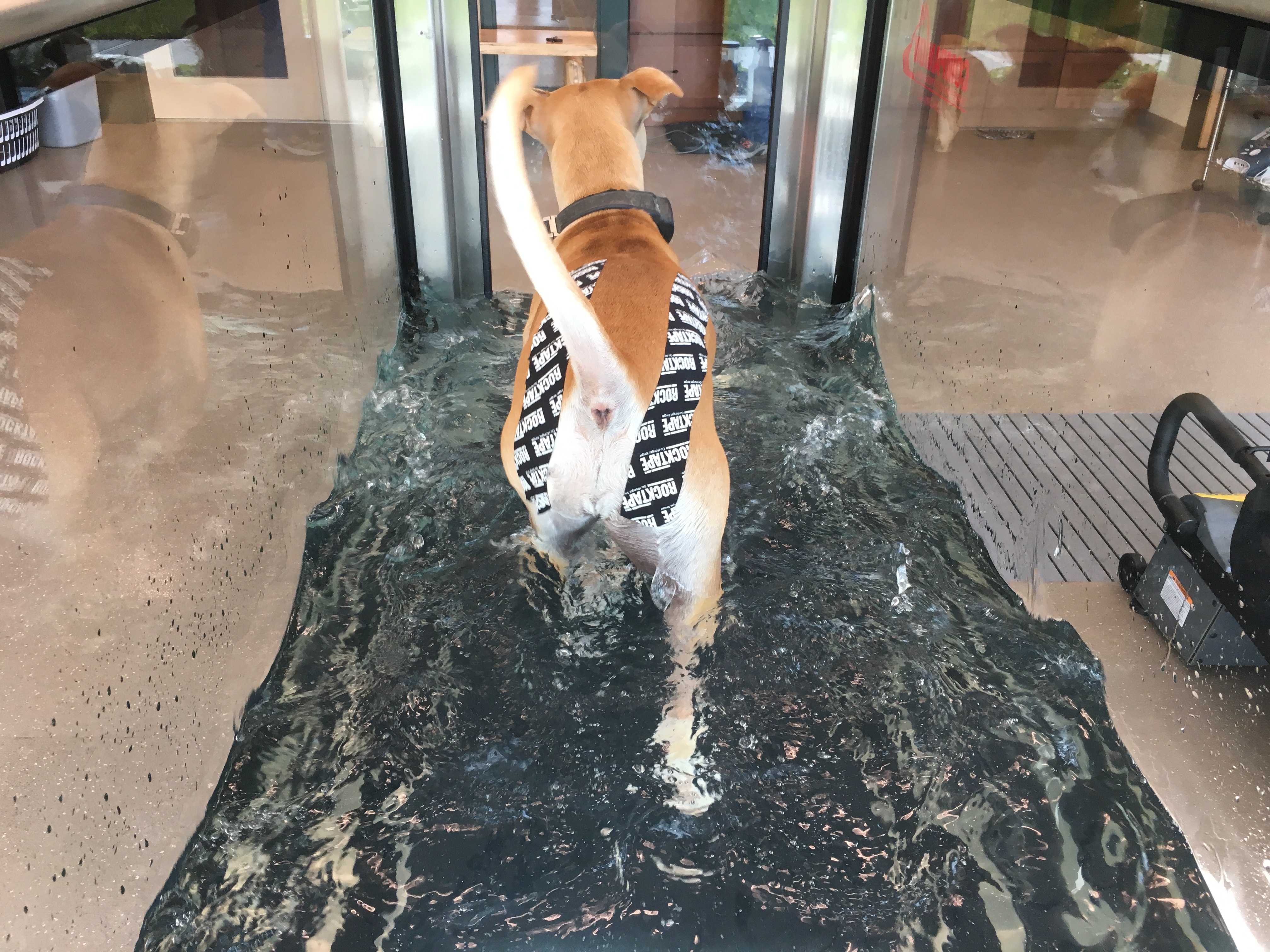
It’s a cotton weave tape that has 180% elongation from its original length. The tight weave provides more durability for the tape in our patients. The non-latex acrylic adhesive is very sturdy. The adhesive is heat activated (just by rubbing your hands on it), and I have yet to need an additional adhesive spray to keep it on my patients. RockTape is waterproof, as is evident by my dog Penny wearing it in the underwater treadmill.
108B3494-2BBC-4924-98F1-E649A8995291

 RockTape comes in 2” and 4” widths, and I have cut the 2” down to 1” for use on my smaller patients. I have to admit the styling colors and designs are a big hit with my clients.

It is a lot more than just tape on skin. When using RockTape we aren’t taping for structure but movement. The tape has a lifting effect on the skin and fascia and this is where the real work happens.

By lifting the skin and fascia, RockTape has many effects. Improving the space between muscle bellies, between skin and fascia and between fascial planes itself allows the body to have better circulation, improved vasodilation, and improved lymphatic drainage. I have found this effect very helpful for post-surgical patients with edema and swelling. I’ve also used RockTape over areas where I anticipate swelling will be and use it pre-emptively.

RockTape also has a mechanical effect by lifting on the tissues to allow for better glide. I have found this very helpful on patients with tight muscles from years of postural changes as compensation from osteoarthritis.

Finally, it has a neurological effect. This is two-fold, the first being pain mitigation. We believe this occurs by Gate Theory. Remember from vet school that non-painful stimuli have been theorized to “close the gate” to painful stimuli, which prevents pain stimulation from reaching the spinal cord.

The other neurological effect is awareness. Small sensory inputs give the body great feedback. In patients with poor posture, the simple application of RockTape gives feedback to their nervous system. To me this is like my grandmother always reminding me to “stand-up straight”.

For patients with impaired neurological systems (Intervertebral Disc Disease [IVDD], Fibrocartilaginous Emboli [FCE], Degenerative Myelopathy [DM], Lumbosacral Disease [LS]), RockTape provides positive feedback on conscious proprioception.

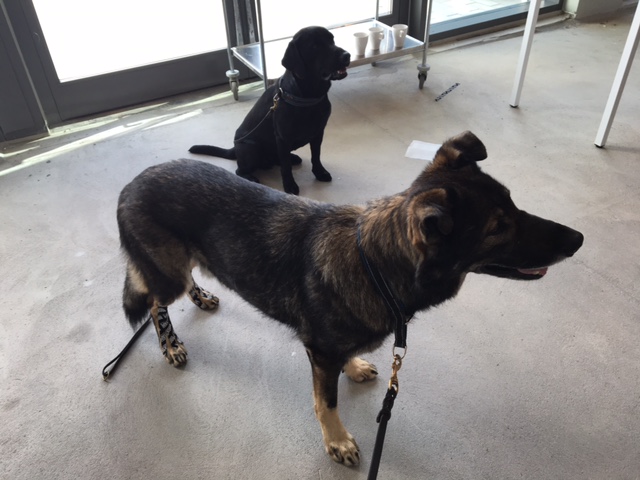
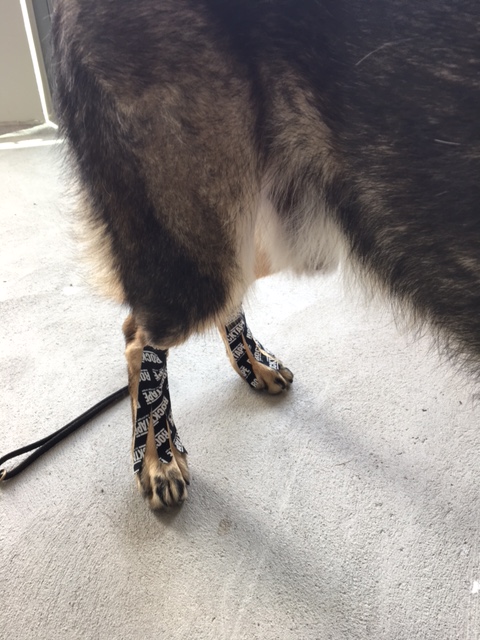
I had a German Shepherd with degenerative myelopathy that would scuff and drag his hind legs. When I applied RockTape to the dorsal aspects of his hind feet, he stopped scuffing. When we took it off, he went right back to scuffing. So we put the tape back on to keep him from scuffing. The principle here is the same as posture. RockTape gave his sensory neurons information telling him where his feet were in space. Without the tape there just wasn’t enough stimulation of the nervous system to tell him that.
IMG_0139

IMG_0136

I also use it RockTape on myself. I’m often hunched over patients (as I’m sure you are too) and I’ve had RockTape on myself for all the reasons listed above for my patients. I also use it for postural awareness, to remind me to keep my shoulders back, my head up. By taking care of ourselves, we can take better care of our patients.

So while the concept of kinesiology taping has been around for almost 40 years, the technology and science are starting to catch up where we can practically and effectively use it on our dogs and cats. New research will be coming available on applications for it, but I encourage you to get out there and try it yourselves.

If you’d like to learn more about kinesiology taping for animals you can take my online course here.

https://shop.multi-versity.com/courses/kinesiology-taping/rocktape-fmt-canine/

Thank you.


Podcast also available on PocketCasts, SoundCloud, Spotify, Google Podcasts, Apple Podcasts, and RSS.

24 responses

  1. This is fascinating information. Is this Taping Course for Veterinarians only? thank you for including me with all of your information.

    Like

    1. The course is for veterinarians, licensed veterinary technicians and physical therapists.

      Like

      1. How about occupational therapists? We have taken courses in Kinesio taping using rock tape,

        Like

      2. Check out rocktape.com/canine for more info.

        Like

  2. not seeing the info on canines, whole page is missing?

    Like

    1. The info is there. Sorry if your computer isn’t showing it.

      Like

  3. I use kinesiology tape on my knee and it really helps! found out about it by accident! Louise

    Like

  4. Very interested in this and have sent an email off to my dog’s massage/physical therapist asking about it. I’m wondering, with the back foot scuffing, do you think vet wrap around the leg just above the ankle would accomplish the same thing? I have a dog with bone cancer in his front shoulder and lumbosacral stenosis. He doesn’t have good back leg awareness and often scuffs, but when we increase his Gabapentin dosage it’s worse for a day or two until he adjusts. I was thinking of trying something like this during those periods to help avoid any stumbling, but I don’t have access to the tape at the moment.

    Like

    1. Vet wrap would constrict, not lift his fascia. So I don’t think you would get a good response. Sorry to hear about your pup. RockTape would be a good option, let me know if you’re having trouble finding a practitioner to help you. If your practitioner has questions, they can contact me.

      Like

  5. Very interesting! Are there any studies on the efficacy of this technique? Thanks!

    Like

    1. There are articles in people and horses. We are working on articles for dogs. Right now just case reports.

      Like

  6. Very interesting article. I currently have Rock Tape on both knees. I am having meniscus issues and my PT taped around my knees to stabilize the area and my knee caps. It really helps. I have a Cardigan Welsh Corgi who is having his second episode with back issues. The first time we were able to work past it with meds and crate rest. This time the meds and crate rest are helping but not as much. Would Rock Tape work for him and if so, where should it go? He is having issues with stiffness and getting up.

    Like

    1. RockTape might be a good option in addition to your current therapy. It would need to be assessed and allied by a veterinary professional.

      Like

  7. How would I find a local vet that uses rock tape?

    Liked by 1 person

    1. Great question. I would check out http://ccrp.utvetce.com/practitioners.asp

      And search for a rehab vet near you. Try that. You can also email me at drmattbrunke@gmail.com and I can try and help you further.

      Like

  8. Trying to buy Rock Tape but there are so many,
    can you specifcally tell me which one to buy for my Greater Swiss dog for her front and back legs.
    Thanks

    Liked by 1 person

    1. You’ll need to have an animal health professional (veterinarian, in some states physical therapist) diagnose and properly apply it the first time. There is a canine and equine specific product for use in animals. Veterinarians have access to it.

      Like

  9. Hello Dr. Brunke,

    I went to the website listed above. Unfortunately, I am unable to access the courses. Can you please provide more information on your upcoming courses or further direct me to a different link with access to the course list? Thank you!

    Like

    1. Sure, check out this blog for further updates. You can also check out utcaninerehab.com for more information, or RockTape.com/Canine

      Like

  10. […] (2017). Kinesiology Taping for Dogs: What’s with all this tape?. [online] Available at: https://drbrunke.wordpress.com/2016/08/18/kinesiology-taping-for-dogs-whats-with-all-this-tape/ [Accessed 17 Mar. […]

    Like

  11. William Castillo

    Such a unique content…Earlier i don’t know,that we can use this tapes for pet animals..

    Like

  12. Hallo Dr. Brunke,
    I have a question about the lifting effect. Because dogs have already so loose skin on their body, is this effect so notable? I can imagine taping the knee, ankle, fingers or elbow, but I am not so convince about the effect on the back for example..
    And you mentioned that you working on some studies for taping the canine and feline patients back in 2016. Is there something released now? I am big fan of taping and have veterinary rehab practice, so I would like to bring taping in for my patients..
    Thank you..

    Like

    1. Great question. If the area has reduced mobility, then the lifting effect is noticeable. It depends on the underlying tissue. Sometimes the lifting is just in the area of a muscle knot, or trigger point. As along the lumbar spine, for example.

      Like

Leave a reply to Elaine Bloom Cancel reply

The Podcast

Join Naomi Ellis as she dives into the extraordinary lives that shaped history. Her warmth and insight turn complex biographies into relatable stories that inspire and educate.

About the podcast